New air pollution report prompts renewed calls for action
Traffic pollution kills more than 700 Aucklanders annually, rivalling smoking, yet action lags. Urgent steps are needed to cut vehicle emissions and prevent avoidable deaths.

A new report reveals that more than 700 Aucklanders are dying every year from traffic-related air pollution - a toll now rivalling smoking - yet little is being done to reduce the human toll, a leading health charity says.
A new University of Auckland report - released by Healthy Auckland Together - found that over 90 per cent of Aucklanders are breathing air that falls short of international health standards, with vehicle emissions responsible for the vast majority of harm.
Nationwide, air pollution killed 3300 Kiwis, and was responsible for more than 13,100 hospital admissions for respiratory and cardiac illnesses, and 13,200 cases of childhood asthma, in 2016.
Ms Letitia Harding, Chief Executive of the Asthma and Respiratory Foundation NZ and Kia Manawanui Trust - The Heart of Aotearoa, says the findings highlight a preventable public health crisis.
"Air pollution is a direct and daily threat to people’s hearts and lungs.
"We are seeing the consequences in asthma, heart disease, and other respiratory illnesses affecting our communities every day."
To address this, there needs to be long-term, Government-led change, Ms Harding says.
"Cleaner air means fewer hospital visits, fewer missed school days, and longer, healthier lives.
"That’s what’s at stake if we fail to act, and why reducing pollution must be treated as a priority."
The report shows transport is responsible for around 80 per cent of harmful air pollution in Auckland. Pollutants like nitrogen dioxide and fine particulate matter can penetrate deep into the lungs and even enter the bloodstream, increasing the risk of stroke, heart disease, lung cancer, and asthma.

Sponsored Content
Dr Ian Longley, Director of The Air Quality Collective, said the scale of harm demands a coordinated national and local response.
"The science is clear and increasingly difficult to ignore.
"Air pollution is contributing to thousands of deaths across New Zealand each year, and much of it is coming from sources we can control - particularly vehicles," Dr Longley says.
"Auckland’s air quality in some areas is comparable to major international cities, yet our policy response has not kept pace with the evidence.
"It’s that gap that is costing lives."
Proven solutions already exist and are being used successfully overseas, he says.
"Other cities around the world have already shown that measures such as low-emission zones, stronger vehicle standards, and investment in public transport can rapidly improve air quality.
"These are practical steps that deliver real health benefits."
The WHO estimates that globally indoor and outdoor air pollution exposure currently kills about seven million people yearly due to cardiovascular diseases, such as strokes and ischaemic heart disease, and respiratory diseases such as acute respiratory infections, chronic obstructive pulmonary diseases and lung cancer.
According to the World Bank, the global health cost of mortality and morbidity attributed to air pollution was $8.1 trillion in 2019.
Related content
Air pollution
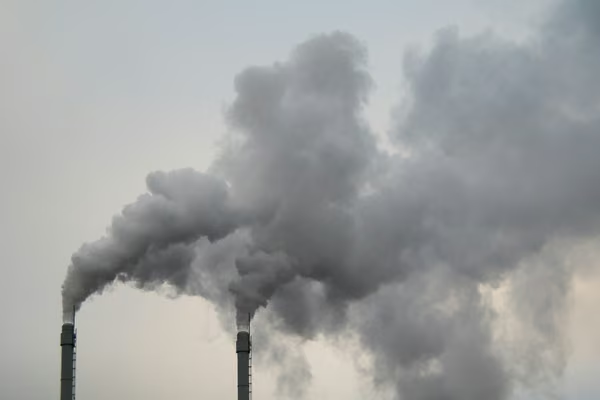
The air we breathe affects our health. We’re calling for clean air to be treated as a public health priority.
Your home and your health

A warm, dry, well-ventilated home is good for everyone, but if you or someone in your whānau lives with a respiratory condition, it can be the difference between staying well and ending up unwell.