World Heart Day
This World Heart Day, we are shining a light on cardiac devices by calling for a clear and consistent way to assess and fund new heart tech, so Kiwis can access the most effective and modern devices.

World Heart Day 2026
The heart technology that could save your life exists, but access is complicated
Getting devices into the country is difficult, approvals are slow, and funding is ad hoc at best. Currently, New Zealand lacks a clear and consistent way to assess and fund new heart technology.
This World Heart Day, we're calling for the country's funding and assessment processes to change, so New Zealanders can access the most effective and up-to-date cardiac care they need.
A model built for medicines, not medical devices
Heart disease remains the leading cause of death globally. In Aotearoa, it kills 1 in 5 people, and costs the country's health system and economy $13.8 billion every year.
The technology to help reduce those numbers exists. Overseas, an alternative to open-heart surgery for certain situations, and a temporary heart pump have already proven effective at saving lives and reducing long-term costs. But in New Zealand, compassionate access is available only in some regions.
The problem is how New Zealand decides which of these get funded. Right now, cardiac devices go through the same assessment process as pharmaceuticals — a process built for pills, not for devices.
Stents, pacemakers, heart valve replacements and heart pumps save lives. Our approval and funding system has to keep pace.
A missed opportunity
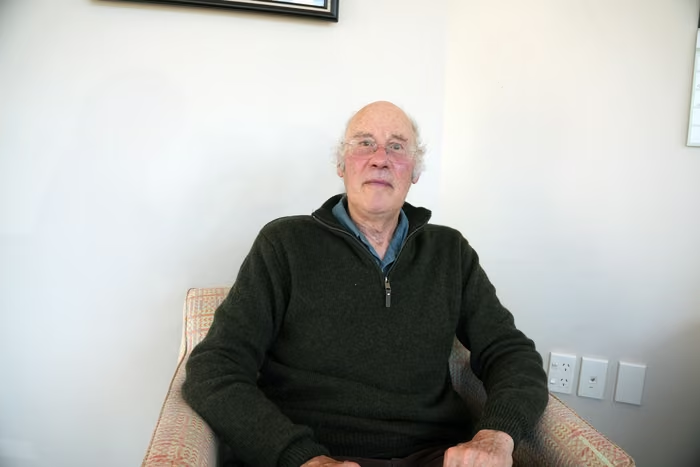
At 83, Robert could have been offered a modern, less invasive option to fix his heart valve. Instead, he was told the only publicly funded option available in New Zealand was open-heart surgery which has left him with painful complications.
Our current New Zealand regulatory processes aren’t keeping up with technological advancement, and patients like Robert are suffering because of this.
What is a cardiac device?
Stents, pacemakers, heart valve replacements and heart pumps save lives. Chances are, you know someone that has one.
Stent
Stent
A tiny mesh tube that a doctor inserts into a narrowed or blocked blood vessel (often a heart artery) to hold it open, restoring normal blood flow. It’s usually placed during a minimally invasive catheter-based procedure.
Valve
Valve
Heart valves act like one-way doors that keep blood flowing in the right direction; when one gets damaged or diseased (too narrow or too leaky), doctors can either repair it or replace it with an artificial one, either through open-heart surgery or a less invasive catheter-based approach depending on the situation.
Pacemaker
Pacemaker
A small device implanted under the skin, usually near the collarbone, that sends gentle electrical pulses to the heart to keep it beating at a steady, healthy rate when the heart's natural rhythm is too slow or irregular.
ICD (Implantable Cardioverter-Defibrillator)
ICD (Implantable Cardioverter-Defibrillator)
Similar to a pacemaker in appearance and placement, but its main job is to detect dangerously fast or chaotic heart rhythms and deliver a shock to reset the heart, preventing sudden cardiac arrest.
Heart pump
Heart pump
A small heart pump that helps support the heart during cardiac surgery when it isn’t able to pump enough blood on its own. Inserted through a blood vessel using a minimally invasive procedure, it temporarily helps maintain blood flow and reduce the workload on the heart while doctors treat the underlying condition.
Five changes worth making
Cardiology is the fastest-moving frontier in medical device innovation — which is why, this World Heart Day, the Cardiac and Respiratory Foundation NZ is calling for a pilot approval and funding pathway for cardiac devices. This has to be separate from the pharmaceutical process, and built on five ideas:
- Conditional, time-limited approval, tied to mandatory real-world evidence collection through device registries.
- Fast-tracked review of upgrades — minor hardware or software improvements to an already-approved device shouldn’t need a full resubmission from scratch.
- Assess cost and clinical benefit together, in a single accelerated process, not sequential reviews stacked years apart.
- Ring-fenced innovation funding, so a device isn’t blocked by a hospital’s tight annual budget cycle when the long-term system savings are clear.
- Formal seats for practising heart specialists — including those who perform these procedures and those who manage heart rhythm problems — at every stage: approval, funding, and reviewing how a device performs after launch.
When the science outruns the system
Heart technology now moves at the speed of consumer electronics — yet we still assess and fund it with a process built for pills. It is time New Zealand gave cardiac devices a pathway of their own.
Read our article featured in NZ Doctor
Support the campaign for improved access to cardiac technology

Use our quick and simple letter template to contact your local MP
New Zealand assesses cardiac devices using a system built for medicines. The mismatch delays access. A letter from a constituent carries more weight than a signature, especially one written in your own words.
World Heart Day 2025
Know Your Numbers
An estimated 1 in 250 Kiwis have Familial Hypercholesterolemia (FH), but less than 2% are diagnosed. FH is an inherited condition that causes dangerously high cholesterol - you could be fit and healthy but still at risk. That's why we're urging everyone to 'Know Your Numbers' by getting your cholesterol checked.
What is Familial Hypercholesterolemia (FH)?
Familial Hypercholesterolemia (FH) is a common inherited genetic condition. People with FH are born with dangerously high levels of ‘bad’ (LDL) cholesterol in the blood from birth, leading to a significantly higher risk of early heart disease.
The risk of heart disease is approx. 20x higher in untreated FH patients. And if a parent has FH, there's a 50% chance their child will inherit it.
You could be at risk of FH if you have:
- Family health history of early heart attacks or heart disease
- Women in your family had heart conditions under 60 years old
- Men in your family had heart conditions under 55 years old
Understanding your cholesterol levels
| Normal range for adults | LDL levels at or above 4.9 mmol/L | If you are at high overall cardiovascular risk, without previous cardiovascular heart disease | If you have had a heart attack or stroke, or have peripheral vascular disease |
|---|---|---|---|
LDL cholesterol should be below 2.6 mmol/L |
May indicate you have Familial Hypercholesterolemia |
LDL cholesterol should be below 1.8 mmol/L |
LDL cholesterol should be below 1.4 mmol/L |

“I want to be around for my son” - A solo dad’s fight with FH
Wellington dad Korie Nicol felt healthy, but a routine checkup revealed he had FH.
“I was shocked when my cholesterol came back so high,” says Korie.
“I thought I could manage with diet alone, but FH isn’t like that – it doesn’t go away.”
Within weeks of his 50th birthday, chest pains led to emergency surgery and two stents.
Cholesterol resources
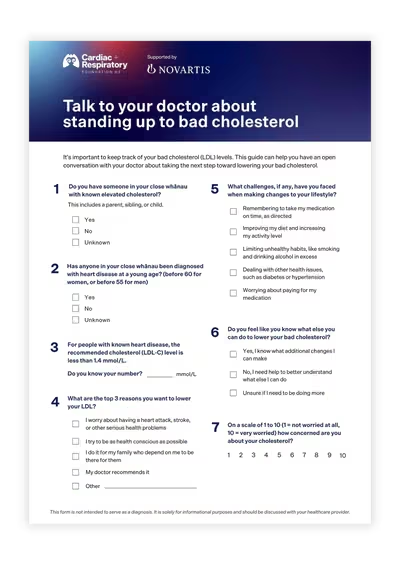
All resourcesTalk to Your Doctor About Standing Up to Bad Cholesterol
This checklist is for people with high cholesterol or a family history of heart disease to bring to their doctor to help understand their LDL levels and discuss next steps.
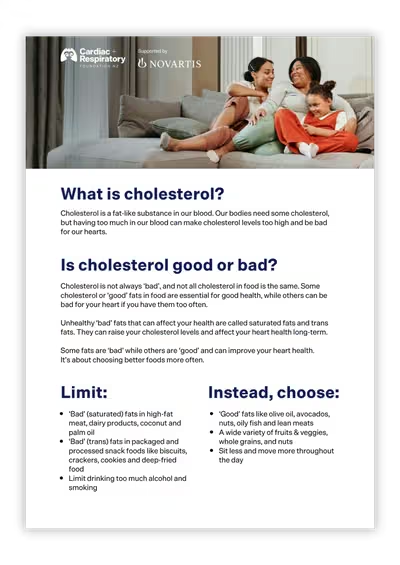
Cholesterol Infographic
This infographic explains what cholesterol is, the difference between good and bad cholesterol, and practical steps to help manage it.