Lung cancer
Lung cancer is New Zealand's deadliest cancer. Learn about the signs and symptoms, risk factors, diagnosis, treatment options and support available.

Lung cancer remains the leading cause of cancer-related death worldwide and has held this position since the 1950s, representing a major global health challenge.
In New Zealand, lung cancer kills more Kiwis than any other cancer and is the fourth most commonly diagnosed cancer in both men and women. Each year, it claims the lives of 1800 Kiwis.
Lung cancer is the most common cancer in New Zealand men, and the second most common in women. Twice as many men as women die from lung cancer.
It disproportionately affects Māori and Pacific peoples, especially Māori women.
What is lung cancer?
Our bodies are made up of tiny cells that typically repair and reproduce themselves. However, occasionally, these cells grow abnormally, forming lumps or tumors.
Lung cancer originates from certain cells within the lungs, often starting in the lining of the airway.
Primary lung cancer is cancer that originated or started in the lungs. Secondary lung cancer is cancer that has started somewhere else in the body (bowel or breast for instance) and spread to the lungs.
The most common cause of changes to cells in the lung is inhalation of tobacco smoke. However, exposure to asbestos, marijuana smoke, and a number of other chemicals can also cause people to develop lung cancer.
Cigarette smoking is the major cause of lung cancer, but it is not known why some smokers develop lung cancer while others do not.
Up to 90% of lung cancer is caused by smoking.
There is also increasing evidence to suggest that environmental tobacco smoke (passive or second-hand smoke) can bring about disease in children and non-smokers.
What are the different types of lung cancer?
There are two main types of lung cancer:
Non-small cell lung cancer (NSCLC) is the most common type of lung cancer. Non-small cell lung cancer refers to a category of lung cancers classified by the type of cells involved and their appearance under microscopic examination. The three primary subtypes are squamous cell carcinoma, large cell carcinoma, and adenocarcinoma. This group accounts for the majority of lung cancer cases. A small proportion of people with NSCLC have a change in a gene called ROS1, which drives the cancer growth.
Small cell lung cancer (SCLC) is a rapidly growing and aggressive form of lung cancer that begins in lung tissue and often spreads quickly to other parts of the body. Under microscopic examination, the cancer cells appear small and oval in shape. About one in five lung cancers are small-cell cancer.
What are the symptoms?
Common signs and symptoms of lung cancer include:
- a cough that doesn’t go away and gets worse over time
- constant chest pain
- coughing up blood
- new onset of shortness of breath, wheeze, or hoarseness
- loss of appetite and/or weight loss
- tiredness
- fever without a known reason
- repeated bouts of bronchitis or pneumonia
- sometimes swelling in the face or neck
These symptoms can also be caused by conditions other than lung cancer. It is important to check with your doctor.
What causes lung cancer?
- Cigarette smoking is the number one risk factor for lung cancer
- Exposure to second-hand smoke
- Ageing
- Family history of lung cancer
- A history of lung disease
- A personal history of cancer
- Exposure to cancer-causing agents (e.g. industrial metals and minerals, including asbestos and silica; chemicals and petroleum products, including diesel exhaust)
- Exposure to air pollution
- Prior radiation to the chest area
Anyone can get lung cancer - one in five people diagnosed with lung cancer have never smoked.
How is it diagnosed?
After a medical professional has reviewed a patient’s medical history, symptoms, risk factors, and examined their chest, they will undertake some or all of the following imaging tests:
- Computed tomography (CT) scan
- Positron emission tomography (PET) scan
- Bone scan
If anything is found in the imaging tests, then tissue or fluid from the lungs is examined further to determine: if lung cancer is present, the type of lung cancer, and if it has spread to other parts of the body. Further tests include:
- Bronchoscopy
- Endobronchial ultrasound
- Endoscopic oesophageal ultrasound
- Mediastinoscopy and mediastinotomy
- Thoracoscopy
- Sputum cytology
- Fine needle aspirate (FNA) biopsy
- Surgical biopsy
What are the treatments available?
The individual will need to be assessed by their doctor to determine the type of treatment that is best for them. Depending on the type of cancer and the extent of its spread, treatment may include surgery, radiation treatment, chemotherapy, targeted treatment, immunotherapy and palliative care, or combinations of these.
Surgery
Surgery
For patients diagnosed with early-stage, non-small cell lung cancer, they may be offered surgery to remove the cancer. It may be the first step in lung cancer treatment, or it may follow other treatments. A surgeon will remove the tumour and some surrounding tissue. At the same time, they will remove a sample of lymph nodes from around the lungs and mediastinum to stage the cancer and help decide if further treatment (e.g. chemotherapy) is needed. There are three main types of surgery for lung cancer:
- Wedge resection: only part of the lung (not a lobe) is removed
- Lobectomy: a lobe of the lung is removed
- Pneumonectomy: one whole lung is removed
Chemotherapy
Chemotherapy
Different medications, or combinations of them, are used for different cancers. Treatment may be given orally (in tablet form), but is more commonly given intravenously via a drip line at an outpatient treatment centre. Chemotherapy treatment for lung cancer is given in cycles. Each treatment cycle is followed by a recovery period.
Lung cancer chemotherapy can be the main type of treatment, or it can be used along with surgery and/or radiation treatment. Lung cancer chemotherapy can be used to shrink the tumour before another treatment or used to kill any cancer cells that are remaining after another treatment. It may also be used in later stages of cancer to relieve cancer symptoms and improve quality of life or extend a patient’s life.
Chemotherapy can damage normal, healthy cells too and therefore causes a number of side effects.
Radiation
Radiation
Lung cancer radiation treatment uses powerful, high-energy X-rays to kill cancer cells or keep them from growing. Radiation treatment can be:
- Used on its own as the main treatment for early-stage lung cancer
- Used before lung cancer surgery to shrink the tumour, or after surgery to kill any remaining cancer cells left in the lungs
- Used to treat cancer that has spread to the lymph nodes within the chest, usually together with chemotherapy, if this is the care plan
- In people who are not well enough to have surgery, or whose cancer has spread too far to have surgery, as palliative treatment
There are different radiation techniques used to treatment lung cancer patients:
- External beam radiation
- Intensity Modulated Radiation Therapy (MRT)
- Stereotactic Radiosurgery (SRS or STRS)
Radiation treatment is given daily or on alternate working days, for just a few minutes. The duration of treatment will be determined by the oncologist.
Treatment is available at specialist treatment centres in Auckland, Hamilton, Tauranga, Palmerston North, Wellington, Christchurch, and Dunedin. Transport and accommodation can be an issue for some patients. There is a National Travel Assistance Programme available.
Localised side effects can occur to the area treated, as well as systemic side effects.
Targeted therapy (biological therapy)
Targeted therapy (biological therapy)
Targeted treatment (often called biological therapy) involves using systemic medication that blocks a specific target, for example a damaged gene or protein, on or in the tumour cells. If a patient’s cancer contains a mutation to a specific gene or protein, they may benefit from targeted treatment. Blocking these targets can kill cancer cells or slow their growth.
Some of the more common targeted lung cancer therapies include:
- Epidermal growth factor receptor (EGFR) inhibitors
- Anti-angiogenesis therapy
- Monoclonal antibodies
Immunotherapy
Immunotherapy
Immunotherapy is a type of cancer treatment that makes your own immune system recognise and kill cancer cells. Currently, immunotherapy is mostly used for patients who have specific advanced stages of lung cancer; it is not suitable for everyone. Whether immunotherapy is viable depends on several clinical factors and patient health. It can sometimes be used following chemotherapy and radiation treatment, where the aim of treatment is to cure the cancer.
Immunotherapy treatment available in New Zealand:
- Pembrolizumab (Keytruda), atezolizumab (Tecentriq) and durvalumab (Imfinzi) are funded for patients who meet the Pharmac Special Authority criteria.
- Pembrolizumab (Keytruda) is funded as a first-line treatment for advanced NSCLC
- Atezolizumab (Tecentriq) is funded as a second or later-line treatment for advanced NSCLC, and durvalumab (Imfinzi) is funded for stage III NSCLC
- Nivolumab (Opdivo) has been approved for use by Medsafe, but is not funded for lung cancer
Useful Resources
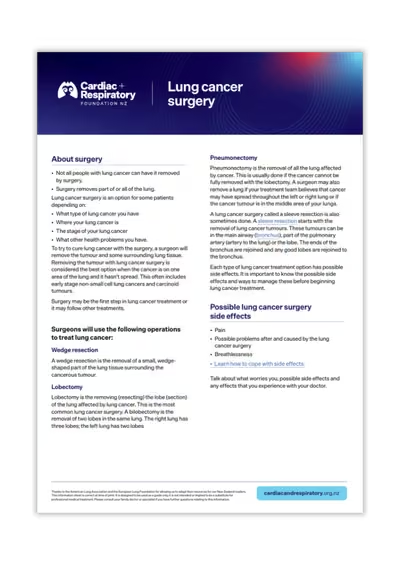
All resourcesLung Cancer Surgery
This brochure explains lung cancer surgery, including when it may be an option and the different types of procedures used to remove lung tumours.
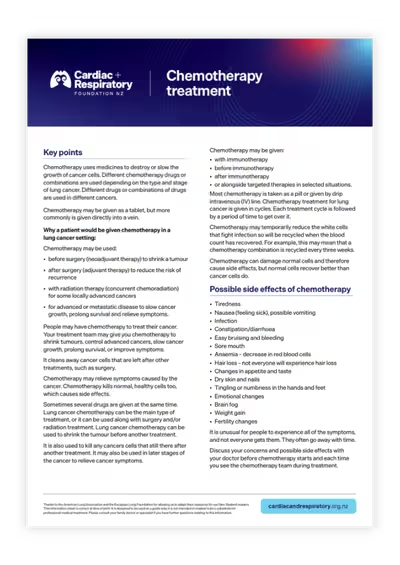
Chemotherapy Treatment Factsheet
This brochure explains chemotherapy as a treatment for lung cancer, including how it works, when it is used, and how it may be given.
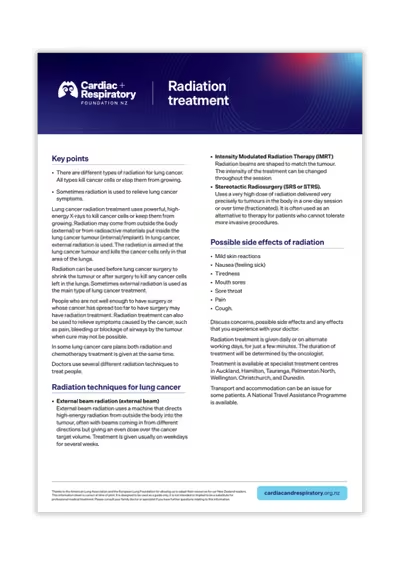
Radiation Treatment
This brochure explains radiation treatment for lung cancer, including how it works, when it may be used, and the different techniques available.
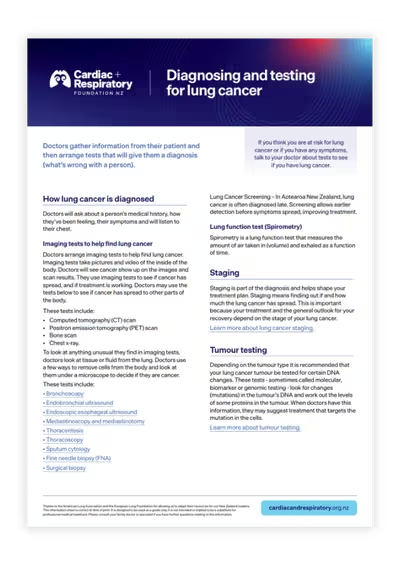
Diagnosing and Testing for Lung Cancer
This brochure explains how lung cancer is diagnosed and tested, including imaging scans, biopsies, lung function tests, staging, and tumour testing.